


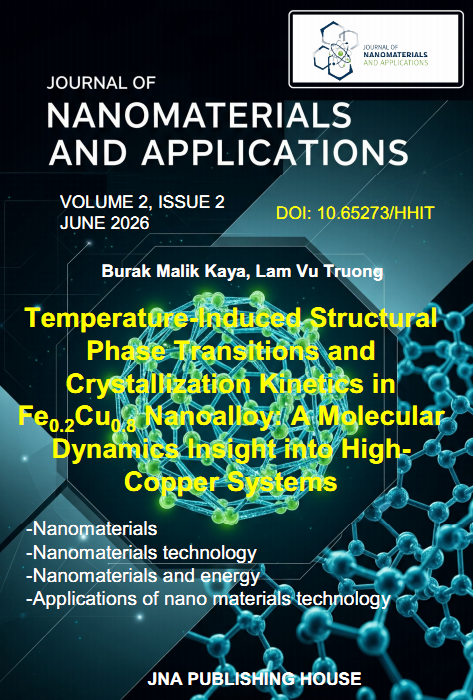
Article, Temperature-Induced Structural Phase Transitions and Crystallization Kinetics in Fe0.2Cu0.8 Nanoalloy: A Molecular Dynamics Insight into High-Copper Systems
Temperature-Induced Structural Phase Transitions and Crystallization Kinetics in Fe0.2Cu0.8 Nanoalloy: A Molecular Dynamics Insight into High-Copper Systems
DOI:
https://doi.org/10.65273/hhit.jna.2026.2.2.040Keywords:
Fe0.2Cu0.8 alloy, Crystallization, Molecular dynamics, Radial Distribution Function, Temperature effectAbstract
This study analyzes the structural evolution and crystallization behavior dependent on temperature of Fe0.2Cu0.8 alloy using molecular dynamics simulation. The results show that at this concentration, the alloy achieves the highest degree of crystallinity and the greatest thermodynamic stability. Radial distribution function analysis shows that Cu–Cu interactions are dominant, while Fe–Cu bonds are weak and peak splitting occurs, reflecting local structural inhomogeneity and phase splitting tendencies. The number of structural units in the crystalline phase of Face Centered Cubic (FCC), Hexagonal Close Packed (HCP), Body Centered Cubic (BCC) increases and the number of amorphous structural units (Amor) decreases significantly. As the temperature increases from 300 K to 1100 K, the structure gradually becomes disordered, the secondary Radial Distribution Function (RDF) peak disappears, and the degree of crystallization decreases. This is marking the phase transition from an ordered to a disordered state
Downloads
References
[1] P. Olsson, C. Domain, J. Wallenius, (2001). Ab initio calculations of defects in Fe and dilute Fe-Cu alloys. Physical Review B, 65(2), 024103. https://doi.org/10.1103/PhysRevB.65.024103
[2] J. Z. Liu, A. van de Walle, G. Ghosh, M. Asta, (2005). Structure, energetics, and mechanical stability of Fe-Cu bcc alloys from first-principles calculations. Physical Review B, 72(14), 144109. https://doi.org/10.1103/PhysRevB.72.144109
[3] F. Soisson, C. C. Fu, (2007). Cu-precipitation kinetics in alpha-Fe from atomistic simulations: Vacancy-trapping effects and Cu-cluster mobility. Physical Review B, 76(21), 214102. https://doi.org/10.1103/PhysRevB.76.214102
[4] G. Bonny, D. Terentyev, L. Malerba, (2004). Structural stability and magnetic properties of metastable Fe-Cu alloys studied by ab initio calculations and molecular dynamics simulations. Physical Review B, 69(5), 054203. https://doi.org/10.1103/PhysRevB.69.054203
[5] M. Kaya, H. Çetin, B. Boyarbay, A. Gök, E. Ayyıldız, (2007). Temperature dependence of the current–voltage characteristics of Sn/PANI/p-Si/Al heterojunctions. Journal of Physics: Condensed Matter, 19(40), 406205. https://doi.org/10.1088/0953-8984/19/40/406205
[6] S. Liu, J. Jie, Z. Guo, S. Yue, T. Li, (2019). A comprehensive investigation on microstructure and magnetic properties of immiscible Cu-Fe alloys with variation of Fe content. Materials Chemistry and Physics, 238, 121909. https://doi.org/10.1016/j.matchemphys.2019.121909
[7] C. Zhang, C. Chen, Z. Guo, et al., (2021). Microstructure and properties of Cu-Fe alloys fabricated via powder metallurgy and rolling. Materials and Manufacturing Processes, 64(4).
https://doi.org/10.1080/00325899.2021.1890403
[8] Y. Ding, X. Xiao, D. Yuan, J. Chen, (2025). A study on the microstructure and properties of Cu-Fe-Mg-Ti alloys based on composition regulation. Materials, 18(6), 1325. https://doi.org/10.3390/ma18061325
[9] Y. Gao, H. Liu, Z. Chen, L. Zuo, J. Zhang, T. Zhang, (2026). Mechanism of liquid-liquid phase separation and crystal nucleation in Fe-Cu immiscible alloy doped with trace Zr. Journal of Alloys and Compounds, 1057, 186769. https://doi.org/10.1016/j.jallcom.2026.186769
[10] W. L. Wang, Y. H. Wu, L. H. Li, W. Zhai, X. M. Zhang, B. Wei, (2015). Liquid-liquid phase separation of freely falling undercooled ternary Fe-Cu-Sn alloy. Scientific Reports, 5, 16335.
https://doi.org/10.1038/srep16335
[11] T. T. T. Giap, K. H. Pham, (2025). Influence of composition on phase transition, crystallization, and glass transition temperatures of Fe1–xCux alloys (x = 0.2, 0.4, 0.5, 0.6, 0.8) studied via molecular dynamics simulations. ACS Omega, 10(31). https://doi.org/10.1021/acsomega.5c02498
[12] A. Caro, M. Caro, E. M. Lopasso, P. E. A. Turchi, D. Farkas, (2006). Thermodynamics of Fe-Cu alloys as described by a classic potential. Journal of Nuclear Materials, 349(3), 317–326.
https://doi.org/10.1016/j.jnucmat.2005.11.004
[13] A. Fantin, G. O. Lepore, M. Widom, S. Kasatikov, A. M. Manzoni, (2023). How atomic bonding plays the hardness behavior in the Al-Co-Cr-Cu-Fe-Ni high entropy family. Small Science, e2300225.
https://doi.org/10.1002/smsc.202300225
[14] D. N. Tran, L. V. Cao, S. Talu, (2022). Molecular dynamics simulation of Bulk Cu Material under Various Factors. Applied Sciences, 12(9), 4437. https://doi.org/10.3390/app12094437
[15] A. Caro, M. Caro, E. M. Lopasso, P. E. A. Turchi, D. Farkas, (2006). "Thermodynamics of Fe–Cu alloys as described by a classic potential." Journal of Nuclear Materials, 349(3), 317–326.
https://doi.org/10.1016/j.jnucmat.2005.11.004
[16] A. Fantin et al., (2023). How Atomic Bonding Plays the Hardness Behavior in the Al-Co-Cr-Cu-Fe-Ni HighEntropy Alloy. Small Sci., 4, e2300225. https://doi.org/10.1002/smsc.202300225
[17] D. Reith, M. Stöhr, R. Podloucky, T. C. Kerscher, S. Müller, (2012). First-principles modeling of temperature and concentration-dependent solubility in the phase-separating alloy FexCu1-x. Phys. Rev. B, 86, 020201. https://doi.org/10.1103/PhysRevB.86.020201
[18] A. I. Dyachenko, V. E. Zakharov, (2016). Spatial equation for water waves. JETP Letters, 103(3), 181–184. https://doi.org/10.1134/S0021364016030048
[19] D. B. Miracle, (2004). A structural model for metallic glasses. Nature Materials, 3(10), 697–702. https://doi.org/10.1038/nmat1219
[20] D. Choudhuri, B. S. Majumdar, (2020). Structural changes during crystallization and vitrification of dilute FCC-based binary alloys. Materialia, 12, 100816. https://doi.org/10.1016/j.mtla.2020.100816
[21] C. Zhang, W. Peng, Y. Shao, M. Oleksandr, L. Lu, X. Zhang, (2024). Study on the melting and sintering behavior of Cu-Fe mixed nanoparticles based on molecular dynamics simulations. Materials & Design, 248, 113457. https://doi.org/10.1016/j.matdes.2024.113457
[22] H. Murdoch, A. Giri, D. Field, E. Hernández-Rivera, M. Guziewski, (2021). Magnetically altered phase stability in Fe-based alloys: Modeling and database development. Calphad, 75, 102360.
https://doi.org/10.1016/j.calphad.2021.102360
[23] S. B. Luo, W. L. Wang, J. Chang, Z. C. Xia, B. Wei, (2014). A comparative study of dendritic growth within undercooled liquid pure Fe and Fe50Cu50 alloy. Acta Materialia, 69, 355-364.
https://doi.org/10.1016/j.actamat.2013.12.009
[24] N. Duxin, N. Brun, C. Colliex, M. P. Pileni, (1998). Synthesis and magnetic properties of elongated Fe-Cu alloys. Langmuir, 14(8), 1984–1989. https://doi.org/10.1021/la9709094
[25] L. Chen, K. Nishida, K. Murakami, D. Chen, L. Liu, T. Kobayashi, Z. Li, N. Sekimura, (2019). A model to evaluate the hardening effect of solute clusters in Fe-based alloys. Nuclear Instruments and Methods in Physics Research Section B: Beam Interactions with Materials and Atoms, 455, 32-34.
https://doi.org/10.1016/j.nimb.2019.06.022
[26] Q. L. Wang, J. Z. Zhao, (2010). A model describing the microstructure evolution in Fe-Cu alloys during thermal aging. Materials Science and Engineering: A, 528(1), 268-272.
https://doi.org/10.1016/j.msea.2010.09.012
[27] R. Ali, B. Kamran, (2017). Identification of Crystal Structures in Atomistic Simulation by Predominant Common Neighborhood Analysis. Computational Materials Science, 126, 182–190.
https://doi.org/10.1016/j.commatsci.2016.09.035
[28] U. Sarac, M. Kaya, M. C. Baykul, (2018). The influence of deposit composition controlled by changing the relative Fe ion concentration on properties of electroplated nanocrystalline Co-Fe-Cu ternary thin films. Turkish Journal of Physics, 42(2), 136-145. https://doi.org/10.3906/fiz-1706-6
[29] U. Sarac, M. Kaya, M. C. Baykul, (2016). Differences observed in the surface morphology and microstructure of Ni-Fe-Cu ternary thin films electrochemically deposited at low and high applied current densities. Journal of Physics: Conference Series, 766(1), 012025. https://doi.org/10.1088/1742-
6596/766/1/012025
[30] S. Plimpton, (1995). Fast parallel algorithms for short-range molecular dynamics. Journal of Computational Physics, 117(1), 1-19. https://doi.org/10.1006/jcph.1995.1039
[31] M. S. Daw, M. I. Baskes, (1984). Embedded-Atom Method: Derivation and Application to Impurities, Surfaces, and Other Defects in Metals. Physical Review B, 29(12), 6443–6453.
https://doi.org/10.1103/PhysRevB.29.6443
[32] D. R. Trinkle, (2025). Computing ternary liquid phase diagrams: Fe-Cu-Ni. Physical Review Materials, 9, 073801. https://doi.org/10.1103/c1zj-cg88
[33] T. Fang, L. Wang, C. X. Peng, Y. Qi, (2012). Liquid immiscibility in an Fe-Cu alloy by molecular dynamics simulation. Journal of Physics: Condensed Matter, 24(50), 505103. https://doi.org/10.1088/0953-8984/24/50/505103
[34] P. Hirel, (2015). Atomsk: A tool for manipulating and converting atomic data files. Computer Physics Communications, 197, 212–219. https://doi.org/10.1016/j.cpc.2015.07.012
[35] M. S. Daw, M. I. Baskes, (1983). Semiempirical, quantum mechanical calculation of hydrogen embrittlement in metals. Physical Review Letters, 50, 1285–1288. https://doi.org/10.1103/PhysRevLett.50.1285
[36] P. H. Hünenberger, (2005). Thermostat algorithms for molecular dynamics simulations. In: Advanced Computer Simulation. Advances in Polymer Science, vol. 173, pp. 105–149. https://doi.org/10.1007/b99427
[37] L. Verlet, (1967). Computer “experiments” on classical fluids. I. Thermodynamical properties of Lennard-Jones molecules. Physical Review, 159, 98–103. https://doi.org/10.1103/PhysRev.159.98
[38] L. Verlet, (1968). Computer “experiments” on classical fluids. II. Equilibrium correlation functions. Physical Review, 165, 201–214. https://doi.org/10.1103/PhysRev.165.201
[39] A. Stukowski, (2010). Visualization and analysis of atomistic simulation data with OVITO–the Open Visualization Tool. Modelling and Simulation in Materials Science and Engineering, 18(1), 015012. https://doi.org/10.1088/0965-0393/18/1/015012
[40] S. Nosé, (1984). A unified formulation of the constant temperature molecular dynamics methods. The Journal of Chemical Physics, 81(1), 511-519. https://doi.org/10.1063/1.447334
[41] D. B. Miracle, (2004). A structural model for metallic glasses. Nature Materials, 3, 697-702. https://doi.org/10.1038/nmat1219
[42] H. W. Sheng, W. K. Luo, F. M. Alamgir, J. M. Bai, E. Ma, (2006). Atomic packing and short-to-medium-range order in metallic glasses. Nature, 439, 419-425. https://doi.org/10.1038/nature04421
[43] T. Egami, (2011). Atomic level stresses. Progress in Materials Science, 56(6), 637-653. https://doi.org/10.1016/j.pmatsci.2011.01.004
Downloads
Published
Data Availability Statement
The data that support the findings of this study are available from the corresponding authors upon reasonable request.
Issue
Section
License
Copyright (c) 2026 Burak Malik Kaya, Lam Vu Truong (Author)

This work is licensed under a Creative Commons Attribution-NonCommercial-ShareAlike 4.0 International License.
1. Grant of License
The Author(s) hereby grant to the Publisher a non-exclusive, perpetual, worldwide, royalty-free, and irrevocable license to publish, reproduce, distribute, and display the Work in all forms and media, whether now known or hereafter developed. This includes but is not limited to print, online, and digital formats. The Publisher may also license the Work to third parties for inclusion in databases, repositories, and other platforms.
2. Author's Warranties
-The Author(s) warrant and represent that:
-The Work is an original creation of the Author(s).
-The Author(s) have the full power and authority to enter into this Agreement and to grant the rights granted herein.
-The Work has not been previously published or licensed for publication in any other journal or book.
-The Work does not infringe upon any copyright, trademark, privacy right, or other proprietary right of any third party.
-All necessary permissions for the use of third-party materials (e.g., figures, tables) have been obtained by the Author(s) and are properly credited in the Work
3. Author's Rights
-The Author(s) retain the following rights:
-The right to use the Work for their own personal, academic, and research purposes, including posting it on their personal website or institutional repository, provided that the published version is not used and the original publication is acknowledged.
-The right to include the Work, in part or in full, in future works of their own (e.g., books, dissertations), provided that proper credit is given to the original publication in this journal.
Journal of Nanomaterials and Applications (JNA)
Add: 14-15A, 7th floor, Charmvit Tower building, 117 Tran Duy Hung, Trung Hoa, Hanoi, 100000, Vietnam
Phone: 084+0904526939 Email: jna.com.vn@gmail.com / jna@jna.com.vn Website: jna.com.vn