

Review, Glass Transition Mechanisms in Metallic Glasses: A Theoretical, Experimental, and Simulation Review
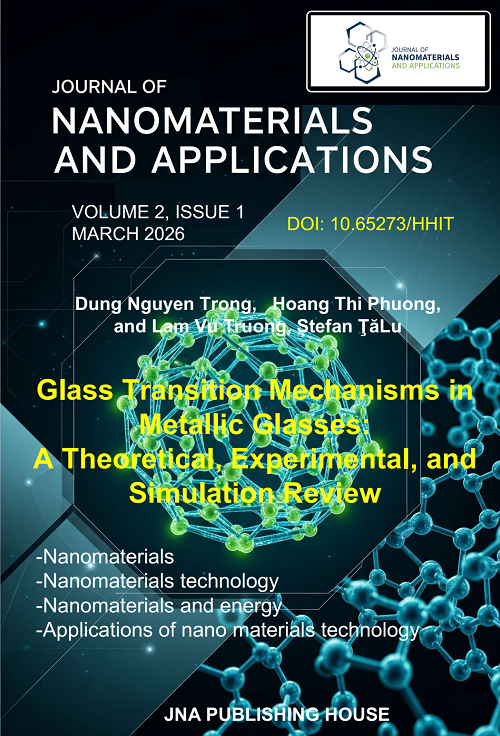
Glass Transition Mechanisms in Metallic Glasses: A Theoretical, Experimental, and Simulation Review
DOI:
https://doi.org/10.65273/hhit.jna.2026.2.1.017Keywords:
metallic glasses; glass transition, short-range order, medium-range order, β-relaxation, differential scanning calorimetryAbstract
Metallic glasses, as a distinct class of amorphous metals, exhibit a unique combination of mechanical robustness, thermal stability, and electronic functionality compared to their crystalline counterparts. Despite extensive studies, the microscopic origin of the glass transition and its dependence on structural heterogeneity remain subjects of ongoing debate. Experimental methods including Differential Scanning Calorimetry (DSC), Flash DSC, Dynamic Mechanical Analysis (DMA), nanoindentation and 5D Scanning Transmission Electron Microscopy (5D-STEM) are reviewed and analyzed. In addition, molecular dynamics (MD) and potential energy simulation models are investigated to establish a relationship with experimental data. Zr-based, Pd-based alloys and high-entropy metallic glasses are compared, in which β relaxation and glass-to-glass transitions are analyzed in detail. From this study, the combination of experiment and simulation has been emphasized as a key for accurate prediction of material properties, and outlines future research directions toward the development of optimized metallic glass systems.
Downloads
References
[1] A. Inoue. (2000). Stabilization of metallic supercooled liquid and bulk amorphous alloys, Acta Materialia, 48, 279–306. https://doi.org/10.1016/S1359-6454(99)00300-6
[2] W. H. Wang. (2012). The elastic properties, elastic models and elastic perspectives of metallic glasses, Prog. Mater. Sci., 57, 487–656. https://doi.org/10.1016/j.pmatsci.2011.07.001
[3] Y.Q. Cheng, E. Ma. (2011). Atomic-level structure and structure–property relationship in metallic glasses, Prog. Mater. Sci., 56, 379–473. https://doi.org/10.1016/j.pmatsci.2010.07.002
[4] J. Schroers, (2010). Processing of bulk metallic glass, Adv. Mater., 22, 1566–1597. https://doi.org/10.1002/adma.200902776
[5] T. Egami, T. Iwashita, W. Dmowski. (2013). Mechanical properties of metallic glasses. Metals, 3(1), 77–113. https://doi.org/10.3390/met3010077
[6] D.V. Louzguine-Luzgin, (2012). A. Inoue, Mechanical properties of bulk metallic glasses, Metals, 3(1):1-22. https://doi.org/10.3390/met3010001
[7] A. Haldar, KS. Liao & S.A. Curran. (2012). Effect of printing parameters and annealing on organic photovoltaics performance. Journal of Materials Research 27, 2079–2087.
https://doi.org/10.1557/jmr.2012.217
[8] I.F. Lancelotti, L. Pereira, K.U. Hess, D.B. Dingwell, E.D. Zanotto. (2024). Flash-DSC provides valuable insights into glass relaxation and crystallization. Journal of Non-Crystalline Solids, 646, 123242. https://doi.org/10.1016/j.jnoncrysol.2024.123242
[9] T. Burgess, M. Ferry. (2009). Nanoindentation of metallic glasses. Materials Today, 12(1-2), 24–32. https://doi.org/10.1016/S1369-7021(09)70039-2
[10] H. Vafaeenezhad, M. Haddad-Sabzevar, A. Rezaee-Bazzaz, A. R. Eivani. (2025). Molecular dynamics simulation study on structure and mechanical properties of (Ti₄₁Zr₂₅Be₂₈Fe₆)₉₃Cu₇ bulk metallic glass. Journal of Alloys and Compounds, 1037, 182617. https://doi.org/10.1016/j.jallcom.2025.182617
[11] A. Stukowski, (2010), Visualization and analysis of atomistic simulation data, Modell. Simul. Mater. Sci. Eng., 18, 015012. https://doi.org/10.1088/0965-0393/18/1/015012
[12] Ș. Țălu, D.N. Trong, L.V. Truong, (2025), Review, The power of simulation: Exploring binary alloys for next-generation applications, Journal of Nanomaterials and Applications, 1(1), 1-16, https://doi.org/10.65273/hhit.jna.2025.1.1.1-16.
[13] T. Burgess, M. Ferry. (2009). Nanoindentation of metallic glasses. Materials Today, 12(1-2), 24–32. https://doi.org/10.1016/S1369-7021(09)70039-2
[14] M. Chen. (2008). Mechanical behavior of metallic glasses: microscopic understanding of strength and ductility. Annual Review of Materials Research, 38, 445–469.
https://doi.org/10.1146/annurev.matsci.38.060407.130226
[15] X.Y. Fu, D. A. Rigney, M. L. Falk. (2003). Sliding and deformation of metallic glass: experiments and MD simulations. Journal of Non Crystalline Solids, 317(1 2), 206–214.
https://doi.org/10.1016/S0022 3093(02)01999 3
[16] Andrea, J.P. Best, P. Djemia, D. Faurie, G. Dehm, M. Ghidelli. (2022). Effect of composition and nanostructure on the mechanical properties and thermal stability of Zr₁₀₀ ₓCuₓ thin film metallic glasses. Materials & Design, 219, 110752. https://doi.org/10.1016/j.matdes.2022.110752
[17] Q. Cheng, S. Lee, J. Orava, W. Wang, Y. Zhang. (2025). Fast scanning calorimetry: From thermal analysis to glass design. Acta Materialia, 120940. https://doi.org/10.1016/j.actamat.2025.120940
[18] J.D. Ferry, (1980), Viscoelastic Properties of Polymers. Wiley.
[19] K.P. Menard. (2008). Dynamic Mechanical Analysis: A Practical Introduction, 2nd ed. CRC Press, Boca Raton. https://doi.org/10.1201/9781420053135
[20] W.C Oliver, & G..M. Pharr, (1992). An improved technique for determining hardness and elastic modulus using load and displacement sensing indentation experiments. Journal of Materials Research, 7(6), 1564-1583. https://doi.org/10.1557/JMR.1992.1564
[21] C.A. Schuh,, T.C. Hufnagel,, & U. Ramamurty, (2007). Mechanical behavior of amorphous alloys. Acta Materialia, 55(12), 4067–4109. https://doi.org/10.1016/j.actamat.2007.01.052
[22] T. Shimojima, A. Nakamura, K. Ishizaka. (2023). Development of five dimensional scanning transmission electron microscopy. Review of Scientific Instruments, 94(2), 023705.
https://doi.org/10.1063/5.0106517
[23] M. Holz, M. Hofmann, C. Weigel, Steffen Strehle. (2025). Advancing glass engineering: Harnessing focused electron beams for direct microstructuring. Small Methods, 9(5), 2401671.
https://doi.org/10.1002/smtd.202401671
[24] W. Kob, C. Hans. Andersen. Testing mode coupling theory for a supercooled binary Lennard Jones mixture. II. Intermediate scattering function and dynamic susceptibility. Physical Review E, 52(4), 4134–4153 (1995). https://doi.org/10.1103/PhysRevE.52.4134
[25] H.W. Sheng, et al. (2006), Atomic packing and short-to-medium-range order in metallic glasses. Nature, 439, 419–425. https://doi.org/10.1038/nature04421
[26] W.H. Wang, C. Dong, & C.H. Shek. (2004). Bulk metallic glasses. Materials Science and Engineering: R, 44(2-3), 45–89. https://doi.org/10.1016/j.mser.2004.03.001
[27] H.S. Chen, & D. Turnbull. (1969). Formation, stability and structure of palladium-silicon based alloy glasses. Acta Metallurgica, 17(6), 1021–1031. https://doi.org/10.1016/0001-6160(69)90048-0
[28] J. Behler. (2021). Four generations of high-dimensional neural network potentials. Chemical Reviews, 121(16), 10037–10072. https://doi.org/10.1021/acs.chemrev.0c00868
[29] L. Tang, T. Q. Wen, N. Wang, Y. Sun, F. Zhang, Z. J. Yang, K. M. Ho, C. Z. Wang. (2018). Structural and chemical orders in Ni₆₄.₅Zr₃₅.₅ metallic glass by molecular dynamics simulation. Physical Review Materials, 2, 033601. https://doi.org/10.1103/PhysRevMaterials.2.033601
[30] L. Zhang, J. Han, H. Wang, W. A. Saidi, R. Car, E. Weinan (2018). End to end symmetry preserving inter atomic potential energy model for finite and extended systems. arXiv preprint, arXiv:1805.09003. https://doi.org/10.48550/arXiv.1805.09003
[31] T. Egami, Y. Waseda. (1984). Atomic size effect on the formability of metallic glasses. Journal of Non Crystalline Solids, 64(1 2), 113–134, https://doi.org/10.1016/0022 3093(84)90210 2
[32] A. Wadowski, et al. (2025). Efficient training of machine learning potentials for metallic glasses: CuZrAl validation. arXiv preprint arXiv:2501.00589. https://doi.org/10.48550/arXiv.2501.00589
[33] R. Zhao, S. C. Wang, Z. Z. Kong, Y. L. Xu, K. Fu, P. Peng, C. L. Wu. (2023). Development of a neuroevolution machine learning potential of Pd Cu Ni P alloys. Materials & Design, 231, 112012.
https://doi.org/10.1016/j.matdes.2023.112012
[34] A. P. Thompson, et al. (2015). Spectral neighbor analysis method for automated generation of quantum-accurate interatomic potentials. Journal of Computational Physics, 285, 316–330.
https://doi.org/10.1016/j.jcp.2014.12.018
[35] D. B. Miracle, & O.N. Senkov,. (2013). A critical review of high-entropy alloys and related concepts. Acta Materialia, 122, 448–511. https://doi.org/10.1016/j.actamat.2016.08.081
[36] Y. Gao, B. Zhao., et al. (2016). Fast Scanning Calorimetry of Phase Transitions in Metals. Springer nature, 691–721. https://doi.org/10.1007/978-3-319-31329-0_21
[37] Z. Tian, Z. Huang, H. Ge, P. Hu, X. Fan, B. Jia. (2024). Applying machine learning to design delicate amorphous micro nano materials for rechargeable batteries. Energy Storage Materials, 71, 103614. https://doi.org/10.1016/j.ensm.2024.103614
[38] A. Inoue, & A. Takeuchi, (2011). Recent development and application products of bulk glassy alloys. MSEA: A, 528(18), 4321–4336. https://doi.org/10.1016/j.actamat.2010.11.027
Downloads
Published
Issue
Section
License
Copyright (c) 2026 Dung Nguyen Trong, Hoang Thi Phuong (Author); Lam Vu Truong (Translator); Stefan Talu (Author)

This work is licensed under a Creative Commons Attribution-NonCommercial-ShareAlike 4.0 International License.
1. Grant of License
The Author(s) hereby grant to the Publisher a non-exclusive, perpetual, worldwide, royalty-free, and irrevocable license to publish, reproduce, distribute, and display the Work in all forms and media, whether now known or hereafter developed. This includes but is not limited to print, online, and digital formats. The Publisher may also license the Work to third parties for inclusion in databases, repositories, and other platforms.
2. Author's Warranties
-The Author(s) warrant and represent that:
-The Work is an original creation of the Author(s).
-The Author(s) have the full power and authority to enter into this Agreement and to grant the rights granted herein.
-The Work has not been previously published or licensed for publication in any other journal or book.
-The Work does not infringe upon any copyright, trademark, privacy right, or other proprietary right of any third party.
-All necessary permissions for the use of third-party materials (e.g., figures, tables) have been obtained by the Author(s) and are properly credited in the Work
3. Author's Rights
-The Author(s) retain the following rights:
-The right to use the Work for their own personal, academic, and research purposes, including posting it on their personal website or institutional repository, provided that the published version is not used and the original publication is acknowledged.
-The right to include the Work, in part or in full, in future works of their own (e.g., books, dissertations), provided that proper credit is given to the original publication in this journal.
Journal of Nanomaterials and Applications (JNA)
Add: 14-15A, 7th floor, Charmvit Tower building, 117 Tran Duy Hung, Trung Hoa, Hanoi, 100000, Vietnam
Phone: 084+0904526939 Email: jna.com.vn@gmail.com / jna@jna.com.vn Website: jna.com.vn