


Review, Recent advances in the application of Density Functional Theory (DFT) and Molecular Dynamics (MD) simulations to elucidate metal corrosion mechanisms
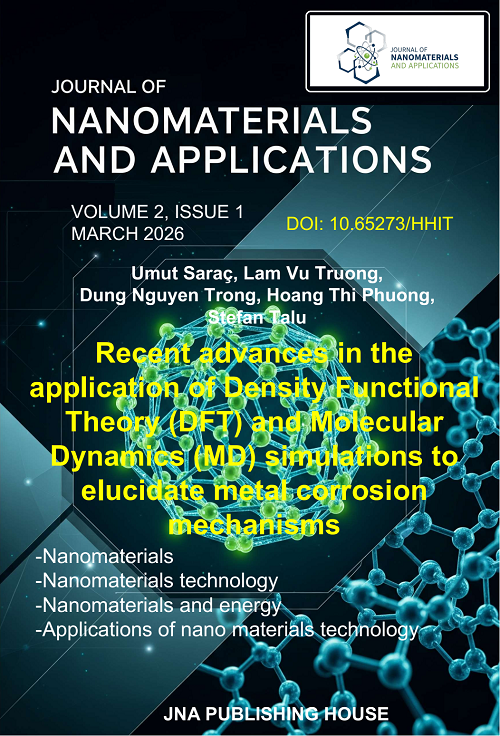
Recent advances in the application of Density Functional Theory (DFT) and Molecular Dynamics (MD) simulations to elucidate metal corrosion mechanisms
DOI:
https://doi.org/10.65273/hhit.jna.2026.2.1.024Keywords:
Metal corrosion, Density Functional Theory, Molecular dynamics simulation, Adsorption mechanism, Multiscale modelAbstract
Over the past decade, atomistic simulation techniques, particularly Density Functional Theory (DFT) and Molecular Dynamics (MD), have become essential for understanding metal corrosion at electronic and atomic scales. DFT offers quantitative insight into adsorption energetics, electronic structure evolution, and reaction pathways governing metal–environment interactions, whereas MD enables dynamic modeling of ion transport, inhibitor adsorption, and passive film stability under realistic conditions. Recent studies show that integrating DFT and MD significantly improves predictive understanding of corrosion involving aggressive species (Cl⁻, SO₄²⁻, H⁺), oxide film growth, alloying effects, and inhibitor performance. Moreover, multiscale approaches linking atomistic simulations with continuum models allow quantitative prediction of corrosion kinetics and material degradation. This review summarizes advances in DFT- and MD-based corrosion modeling from 2020 to 2025, discusses key methodological limitations, and highlights emerging trends such as reactive force fields, ab initio molecular dynamics, and machine learning-assisted simulations, with emphasis on validation and predictive reliability.
Downloads
References
[1] D.T. Kallikragas, I.M. Svishchev. (2018). Atomistic simulations of corrosion related species in nano-cracks. Corrosion Science, 135, 255–262. https://doi.org/10.1016/j.corsci.2018.02.056
[2] C. Gattinoni, A. Michaelides, (2015). Understanding corrosion with first-principles methods. Faraday Discussions, 180, 439–458. https://doi.org/10.1039/C4FD00273C
[3] X. Wang, et al. (2023). Atomic-scale insight into chloride-induced corrosion mechanisms. Corrosion Science, 222, 111402). https://doi.org/10.1016/j.corsci.2023.111402
[4] L. Du, et al. (2022). Reactive molecular dynamics study on corrosion behaviors of carbon steel. Computational Materials Science, 203, 111142. https://doi.org/10.1016/j.commatsci.2021.111142
[5] N.I.N. Haris, et al. (2021). Overview of molecular dynamics simulation for corrosion inhibition. Metals, 11(1), 46. https://doi.org/10.3390/met11010046
[6] Y. Oukhrib, et al. (2021). DFT, Monte Carlo and MD simulations of corrosion inhibitors on Cu(111). Scientific Reports, 11, 3771. https://doi.org/10.1038/s41598-021-82927-5
[7] K. Haruna, A. Musa, M.A. Lawal, Z. Muhammad, T.A. Saleh. (2025). Experimental and DFT study of the corrosion inhibition potential of expired diclofenac potassium on stainless steel in hydrochloric acid solution. Environmental Surfaces and Interfaces, 3, 134–145. https://doi.org/10.1016/j.esi.2025.04.001
[8] J. Robles, et al. (2024). Molecular modelling applied to corrosion inhibition: A critical review. npj Materials Degradation, 8, 72 https://doi.org/10.1038/s41529-024-00478-2
[9] S. Umut , C.A. Tuan, N.T. Giang, Ş. Ţălu, (2025). Influence of Copper Electrode Material on Surface Quality in Electrical Discharge Machining Drilling of Heat-Treated C45 Steel, Journal of Nanomaterials and Applications, 1(1), 33–42. https://doi.org/10.65273/hhit.jna.2025.1.1.33-42.
[10] S. Hakimian, et al. (2023). Machine learning classification of corrosion behavior. Computational Materials Science, 228, 112352 https://doi.org/10.1016/j.commatsci.2023.112352
[11] L. Chen. (2015). The Materials Genome Initiative and Advanced Materials. Materials Science Advanced Materials Engineering. 1(2): 169. https://doi.org/10.15302/J-ENG-2015056
[12] X. Wang, J. Song, H. Zhou, X. Fan ( 2023) Mechanism of dendrite segregation on corrosion behaviour of antique cast low Sn bronze. Corrosion Science, 222(12):111402.
https://doi.org/10.1016/j.corsci.2023.111402
[13] X. Gattinoni, A. Michaelodes. (2015). Atomistic details of oxide surfaces and surface oxidation: the example of copper and its oxides. Surface Science Reports, 424-447.
https://doi.org/10.1016/j.surfrep.2015.07.001
[14] A. Tamm, A. Tarre, V. Verchenko, H. Seemen. (2020). Atomic Layer Deposition of Superconducting CuO Thin Films on Three-Dimensional Substrates. MDPI, 10(8), 650. https://doi.org/10.3390/cryst10080650
[15] C. Malica, K. S Novoselov, A. S. Barnard, S. V. Kalinin. (2025). Artificial intelligence for advanced functional materials: exploring current and future directions. JPhys Materials, 8, 021001.
https://doi.org/10.1088/2515-7639/adc29d
[16] M. Adnan, G. V. Prakash. (2021). Study of Surface and Bulk Recombination Kinetics of Two-Dimensional Inorganic–Organic Hybrid Semiconductors under Linear and Nonlinear Femtosecond Transient Absorption Analysis. The Journal of Physical Chemistry C, 125, 22, 12166–12174.
https://doi.org/10.1021/acs.jpcc.1c02351
[17] K. Jiao, T. Yamamoto, H. Kiuchi, H. Zhao. ( 2024). Mn-Based Transition Metal Oxide Positive Electrode for K-Ion Battery Using an FSA-based Ionic Liquid Electrolyte J. Electrochem. Socciety., 171, 10.
https://doi.org/10.1149/1945-7111/ad803a
[18] H. Liu, J. Zhai, (2025) Carbon Emission Modeling for High-Performance Computing-Based AI in New Power Systems with Large-Scale Renewable Energy Integration. MDPI, 13, 2, 595.
https://doi.org/10.3390/pr13020595.
[19] M. Zawlocka, M. Zajac, R. Riedel. ( 2013). Composite Materials Based on Polymer-Derived SiCN Ceramic and Disordered Hard Carbons as Anodes for Lithium-ion Batteries. ournal of Power Sources. 244:80-86. https://doi.org/10.1016/j.jpowsour.2013.03.137
[20] Oukhrib, Abdellaoui, Bourzi. (2021). DFT, Monte Carlo and molecular dynamics simulations for the prediction of corrosion inhibition efficiency of novel pyrazolylnucleosides on Cu(111) surface in acidic media. Scientific Reports, 11(1):3771. https://doi.org/10.1038/s41598-021-82927-5
[21] C. Zhang, K. Hao, W. Chen, Y. Zhang. (2025). Potential impact of microbial corrosion on torrefied biochar for solid biofuel utilization: A critical review. Bioresource Technology, 37, 133143.
https://doi.org/10.1016/j.biortech.2025.133143
[22] J. Torralba, A. Meza, S. Vkumaran, A. Mostafaei, A.Mohammadzaded. ( 2025). From high-entropy alloys to alloys with high entropy: A new paradigm in materials science and engineering for advancing sustainable metallurgy. Current Opinion in Solid State and Materials Science. 36, 101221.
https://doi.org/10.1016/j.cossms.2025.101221
[23] E. Laudadio, E. Mohebbi, E. Pavoni, C. Minnelli, S. Sabbatini, P. Stipa, et al. (2023). Density functional theory and molecular dynamics studies on electrical, mechanical, and thermal properties of TiO₂ nanoparticles interacting with poly-lactic-co-glycolic acid. Colloids and Surfaces A: Physicochemical and Engineering Aspects, 667, 131388. https://doi.org/10.1016/j.colsurfa.2023.131388
[24] G. Madhavi, N. Kishan, C.R. Raghavendra. (2022). A review on recent approaches in the field of surface coating. Materials Today: Proceedings, 52(3), 403–406. https://doi.org/10.1016/j.matpr.2021.09.075
[25] G.A. El-Awadi, (2023). Review of effective techniques for surface engineering material modification for a variety of applications. AIMS Materials Science, 10(4), 652-692.
https://doi.org/10.3934/matersci.2023037
[26] L. Wei , Ziyuan Gao, ( 2023). Recent research advances on corrosion mechanism and protection, and novel coating materials of magnesium alloys: a review RSC Advances, 13, 8427-8463.
https://doi.org/10.1039/D2RA07829E
[27] E. Emmanuel Oguzie, C. Ekeocha. O. Ikenna. (2024). Corrosion protection of mild steel in corrosive media, a shift from synthetic to natural corrosion inhibitors: a review. Bulletin of the National Research Centre, 48, 26. https://doi.org/10.1186/s42269-024-01181-7
[28] S,W. Zhong, S. Huang, X. He . (2025). Research Progress on the Corrosion Mechanism and Protection Monitoring of Metal in Power Equipment. MDPI, 15(2), 119. https://doi.org/10.3390/coatings15020119
[29] B. Liu, J. Lili, Y. Zhang ( 2022) Progress in corrosion-resistant coatings on surface of low-alloy steel: a review.” Progress in Natural Science: Materials International. 30, 193-215.
https://doi.org/10.1007/s42243-022-00872-7
[30] M. Higrekar, V. Amdoskar, (2024). A review on recent progress and techniques used for fabricating superhydrophobic coatings derived from biobased materials. RSC Advances, 14, 32668. https://doi.org/10.1039/D4RA04767B
[31] L. Wei, Z. Gao, (2023). Recent research advances on corrosion mechanism and protection, and novel coating materials of magnesium alloys: a review. RSC Advances, 13, 8427-8463. 5.
https://doi.org/10.1039/D2RA07829E
[32] N. Kumar, V. Choubey. (2023). Recent trends in coating processes on various AISI steel substrates: A review. Journal of Materials Science. 59, 395-422. https://doi.org/10.1007/s10853-023-09239-z
[33] Barroso, Q. Li, R. Bordia, G. Motz. (2019). Polymeric and ceramic silicon-based coatings – a review. Journal of Materials Chemistry A. https://doi.org/10.1039/C8TA09054H
[34] M.L. Grilli, D. Valerini, A.E. Slobozeanu, B.O. Postolnyi, S. Balos, A. Rizzo, R.R. Piticescu. (2021). Critical raw materials saving by protective coatings under extreme conditions: a review of last trends in alloys and coatings for aerospace engine applications. Materials, 14(7), 1656. https://doi.org/10.3390/ma14071656
[35] C. Ekeocha, I. Onyeachu, I. B.; Etim, I.; Oguzie, E. E. (2023). Review of forms of corrosion and mitigation techniques: A visual guide. African Scientific Reports, 2023. https://doi.org/10.46481/asr.2023.2.3.117.
[36] L. Chen. (2015). The Materials Genome Initiative and Advanced Materials. Engineering. 1(2):169. https://doi.org/10.15302/J-ENG-2015056
[37] N. Marana, F. Silveri, E. Gome, A. Ferrari. (2014). A computational study of the negative LiIn modified anode and its interaction with β-Li3PS4 solid–electrolyte for battery applications†. Physicals Chemistry, 26, 15648-15656. https://doi.org/10.1039/D4CP00102H
[38] S. Kumar, M. Rao, D. Padma. (2025). Process simulation and modeling of biogas conversion to dimethyl ether using Aspen Plus. https://doi.org/10.1080/17597269.2025.2528316
[39] B. Usman, Z. Gasem, S. Umoren, M. Solomon. (2019). Eco-friendly 2-Thiobarbituric acid as a corrosion inhibitor for API 5L X60 steel in simulated sweet oilfield environment: Electrochemical and surface analysis studies. Scientific reports, 830. https://www.nature.com/articles/s41598-018-37049-w
[40] L. Wang, K.Liu S. Geng. ( 2024). A Review on Corrosion Behavior and Surface Modification Technology of Nickel Aluminum Bronze Alloys: Current Research and Prospects. Advaned Engineering Materials, 27, 1, 2401779. https://doi.org/10.1002/adem.202401779
[41] A. Reda, Mohamed A, P. Montague. (2024). Review of Material Selection for Corrosion-Resistant Alloy Pipelines. Engineered Science, 2025, 33, 1373. https://doi.org/10.30919/es1373
[42] S. Prakash, M.K. Srinath (2024) A review on corrosion resistant materials and coatings. Engineering. 2965. https://doi.org/10.1063/5.0215981
[43] S. Shiva, M.K. Srinath, S. Praveen, M. Narrayanan. (2024). A review on corrosion resistant materials and coatings. Materials Engineering. 2965. https://doi.org/10.1063/5.0215981
[44] D. Dwivedi, K. Lepkova, T. Becker. ( 2016). Carbon steel corrosion: a review of key surface properties and characterization methods. Royal Society of Chemistry, 7, 4580-4610.
https://doi.org/10.1039/C6RA25094G
[45] H.P. Fu. (2023). A comprehensive review of nature-based solutions: current status and future research. AIMS Enironmental Science, 10, 5, 677-690. https://doi.org/10.3934/environsci.2023037
[46] L. Wei, Z. Gao. ( 2023) . Recent research advances on corrosion mechanism and protection, and novel coating materials of magnesium alloys: a review. RSC Advances, 14;13(12):8427–8463.
https://doi.org/10.1039/d2ra07829e
[47] L. Du, J. Chen, E. Hu, F. Zeng. (2022). A reactive molecular dynamics simulation study on corrosion behaviors of carbon steel in salt spray. Computational Materials Science, 203, 111142.
https://doi.org/10.1016/j.commatsci.2021.111142.
[48] D.R. Gunasegaram, M. Venkatraman, I. Cole, (2014). Towards multiscale modelling of localised corrosion. International Materials Reviews, 59(2), 84-114.
https://doi.org/10.1179/1743280413Y.0000000024.
[49] M.F. Horstemeyer et al., (2024). A Multiscale Inelastic Internal State Variable Corrosion Model . Materials, 17(16), 3995. https://doi.org/10.3390/ma17163995.
[50] M. Bordonhos, T. Galvao, D. Gouveia. (2022). Multiscale Computational Approaches toward the Mechanics of Materials. Advanced Theory and Simulation, 6, 10, 2200628.
https://doi.org/10.1002/adts.202200628.
[51] G. Qian, J. Zeng, Z. Hu, M. Todd. (2024). Bayesian Model Updating of Multiscale Simulations Informing Corrosion Prognostics Using Conditional Invertible Neural Networks. ASME. The American Socjety of Engineering, 11(1): 011105. https://doi.org/10.1115/1.4065845
[52] H. Zhao, Y. Wu, S. Zhang, A. Mingers, (2024). How solute atoms control aqueous corrosion of Al-alloys. Nature Communication 15, 561. https://doi.org/10.1038/s41467-024-44802-5
[53] Y. Zhao et al., (2023), npj Computational Materials, 9, 94. https://doi.org/10.1038/s41524-023-01038-z.
[54] A.I. Ikeuba, B.I. Ita, C.P. Okonkwo, P.E. Ekuri, H.O. Edet, & P.C. Iwuji, (2024). Review of computational methods used in the evaluation corrosion inhibition of metallic materials. Discover Chemical Engineering, 4, 28. https://doi.org/10.1007/s43938-024-00065-6
[55] N. Mouats, S. Djellali, A. Sedik, Y. Benguerba, (2024). Comprehensive Investigation of the Adsorption, Corrosion Inhibition and Mechanism for an Eco-Friendly Inhibitor on Mild Steel in Acidic Medium: Experimental and DFT Study. ACS Omega, (6), 4279-4290. https://doi.org/10.1021/acsomega.3c10240
[55] A. Amiery, A. Mohamad, H. Kadhum. (2022). Experimental and theoretical study on the corrosion inhibition of mild steel by nonanedihydrazide in hydrochloric acid solution. Scientific Reports, 12:4705. https://doi.org/10.1038/s41598-022-08146-8.
[56] N.I.N. Haris, S. Sobri, Y.A. Yusof, N.K. Kassim. (2021). An Overview of Molecular Dynamic Simulation for Corrosion Inhibition of Ferrous Metals. Metals, 11(1), 46. https://doi.org/10.3390/met11010046.
[57] K. Shashirekha, V. Vijayakumar, Subramanian, (2024). Experimental, electrochemical and DFT simulation studies on corrosion inhibition of mild steel by novel organic inhibitor: SEM and AFM evidence of protective film formation. Corrosion Science, 208, 111136 . https://doi.org/10.1016/j.corsci.2024.111136.
[58] X. Ji, A. Seif, J. Duan, A. Rashidi. (2022). Experimental and DFT studies on corrosion protection performance of epoxy/graphene quantum dots@TiO2 nanotubes coatings. Construction and Building Materials 322(1):126501. https://doi.org/10.1016/j.conbuildmat.2022.126501
[59] X. Ming, Y. Cai, Z. Li (2022) Atomic scale insight into the mechanisms of chloride induced steel corrosion in concrete. Construction and Building Materials, 351, 128811.
https://doi.org/10.1016/j.conbuildmat.2022.128811
[60] J. Robles, E. Martin, P. Ordejon, I. Cole. (2024). Molecular modeling applied to corrosion inhibition: a critical review. NPI Material degradation, 8, 72. https://doi.org/10.1038/s41529-024-00478-2
[61] L. Coelho, D. Zhang, Y. Ingelgem, A. Terryn. (2022). Reviewing machine learning of corrosion prediction in a data oriented way. npj Materials Degradation, 6, 107. https://doi.org/10.1038/s41529-022-00218-4.
[62] J. Castillo, E. Martin, P. Cole. (2024). Molecular modelling applied to corrosion inhibition: a critical review. npj Materials Degradation. https://doi.org/10.1038/s41529-024-00478-2.
[63] H. Gong, L. Ma, D. Liu, D. Zhang. (2025). Ai-Driven Discovery of High-Performance Corrosion Inhibitors Using a Bert-Gpt Framework for Molecular Generation. SSRN, 25. https://doi.org/10.2139/ssrn.5346603.
[64] L.Y., W. Chen, W. Hao, J. Wang, X. Guo, L., Ma, D. Zhang, (2024). Electrical Materials & Applications, e12006. https://doi.org/10.1049/ema 3.12006.
[65] G. Cao, Y. Ruan, J. Liu, Z. Hu, H. Zhu. (2025). Preparation and properties study of self healing anticorrosive coating based on MCM 41 nanocontainer and triazinyl corrosion inhibitor. Scientific Reports, 15:22288. https://doi.org/10.1038/s41598-025-06528-2
[66] M. Li, H. Henein, C. Zhou, J. Liu. (2024). Towards high-entropy alloys with high-temperature corrosion resistance and structural stability. Journal of Materials Science & Technology, 174, 133-144.
https://doi.org/10.1016/j.jmst.2023.07.035.
[67] Y. Wang, S, Chen, X. Zheng, D. Li, M. Ma. ( 2025). Effect of Porosity on the Corrosion Behavior of FeCoNiMnCrx Porous High-Entropy Alloy in 3.5 Wt.% NaCl Solution. MDPI, 15(2), 210.
https://doi.org/10.3390/met15020210
[68] S. Hakimian, H. A. Bouzid, L. Abia Hof, etc. (2023). Application of machine learning for the classification of corrosion behavior in different environments for material selection of stainless steels. Computational Materials Science, 228, 112352. https://doi.org/10.1016/j.c
Downloads
Published
Issue
Section
License
Copyright (c) 2026 Umut Saraç, Lam Vu Truong, Dung Nguyen Trong, Hoang Thi Phuong, Stefan Talu (Author)

This work is licensed under a Creative Commons Attribution-NonCommercial-ShareAlike 4.0 International License.
1. Grant of License
The Author(s) hereby grant to the Publisher a non-exclusive, perpetual, worldwide, royalty-free, and irrevocable license to publish, reproduce, distribute, and display the Work in all forms and media, whether now known or hereafter developed. This includes but is not limited to print, online, and digital formats. The Publisher may also license the Work to third parties for inclusion in databases, repositories, and other platforms.
2. Author's Warranties
-The Author(s) warrant and represent that:
-The Work is an original creation of the Author(s).
-The Author(s) have the full power and authority to enter into this Agreement and to grant the rights granted herein.
-The Work has not been previously published or licensed for publication in any other journal or book.
-The Work does not infringe upon any copyright, trademark, privacy right, or other proprietary right of any third party.
-All necessary permissions for the use of third-party materials (e.g., figures, tables) have been obtained by the Author(s) and are properly credited in the Work
3. Author's Rights
-The Author(s) retain the following rights:
-The right to use the Work for their own personal, academic, and research purposes, including posting it on their personal website or institutional repository, provided that the published version is not used and the original publication is acknowledged.
-The right to include the Work, in part or in full, in future works of their own (e.g., books, dissertations), provided that proper credit is given to the original publication in this journal.
Journal of Nanomaterials and Applications (JNA)
Add: 14-15A, 7th floor, Charmvit Tower building, 117 Tran Duy Hung, Trung Hoa, Hanoi, 100000, Vietnam
Phone: 084+0904526939 Email: jna.com.vn@gmail.com / jna@jna.com.vn Website: jna.com.vn