


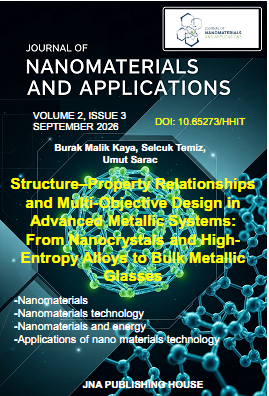
Review, Structure–Property Relationships and Multi-Objective Design in Advanced Metallic Systems: From Nanocrystals and High-Entropy Alloys to Bulk Metallic Glasses
Structure–Property Relationships and Multi-Objective Design in Advanced Metallic Systems: From Nanocrystals and High-Entropy Alloys to Bulk Metallic Glasses
DOI:
https://doi.org/10.65273/hhit.jna.2026.2.3.045Keywords:
Nanostructured metals, High-entropy alloys, Grain boundary engineering, Strength-ductility trade-off, Passivation & Corrosion resistanceAbstract
This review provides a comprehensive analysis of nanostructured metals, high-entropy alloys (HEAs), and bulk metallic glasses (BMGs), focusing on structure–property relationships across atomic, defect, and microstructural scales. This review elucidates the fundamental processing routes and governing mechanisms responsible for structural evolution across nanostructured metallic systems. Furthermore, recent evidence re-evaluating sluggish diffusion in HEAs and mechanisms ensuring structural stabilization are critically examined. Differences in atomic diffusion kinetics across the three material classes are systematically delineated. Finally, an AI-assisted framework and multi-objective design roadmap are presented for future intelligent metallic systems in aerospace, green energy, and biomedical applications.
Downloads
References
[1] N. Zhou, T. Hu, J. Luo, (2016). Grain boundary complexions in multicomponent alloys: Challenges and opportunities, Curr. Opin. Solid State Mater. Sci. 20 (5), 268–277.
https://doi.org/10.1016/j.cossms.2016.05.001
[2] E. P. George, W. A. Curtin, C. C. Tasan, (2020). High-entropy alloys: A focused review of mechanical properties and deformation mechanisms, Acta Mater. 188, 435–474.
https://doi.org/10.1016/j.actamat.2019.12.015
[3] U. Sarac, M. Kaya, M. C. Baykul, (2017). Synthesis of Ni-Fe thin films by electrochemical deposition technique and characterization of their microstructures and surface morphologies, Turk. J. Phys. 41, 536–544. https://doi.org/10.3906/fiz-1706-8
[4] U. Sarac, M. Kaya, M. C. Baykul, (2019). A Comparative Study on Microstructures, Magnetic Features and Morphologies of Ternary Fe–Co–Ni Alloy Thin Films Electrochemically Fabricated at Different Deposition Potentials, J. Supercond. Nov. Magn. 32, 917–923. https://doi.org/10.1007/s10948-018-4774-9
[5] U. Sarac, M. Kaya, M. C. Baykul, (2020). Bath temperature-dependent structural properties, coercive force, surface morphology and surface texture of electrochemically grown nanostructured Ni–Co/ITO thin films, Appl. Phys. A 126, 239. https://doi.org/10.1007/s00339-020-3423-x
[6] U. Sarac, M. Kaya, M. C. Baykul, (2016). Differences observed in the surface morphology and microstructure of Ni-Fe-Cu ternary thin films electrochemically deposited at low and high applied current densities, J. Phys.: Conf. Ser. 766, 012025. https://doi.org/10.1088/1742-6596/766/1/012025
[7] R. Nartiță, D. Ionita, I. Demetrescu, (2025). The performance of high-entropy alloys in aggressive environments, Ann. Acad. Rom. Sci. Ser. Phys. Chem. 9 (2), 26–40.
https://doi.org/10.56082/annalsarsciphyschem.2024.2.26
[8] B. Boyarbay, H. Çetin, M. Kaya, E. Ayyildiz, (2008). Correlation between barrier heights and ideality factors of H-terminated Sn/p-Si (1 0 0) Schottky barrier diodes, Microelectron. Eng. 85 (4), 721–726.
https://doi.org/10.1016/j.mee.2008.01.005
[9] M. Kaya, H. Çetin, B. Boyarbay, A. Gök, E. Ayyildiz, (2007). Temperature dependence of the current–voltage characteristics of Sn/PANI/p-Si/Al heterojunctions, J. Phys.: Condens. Matter 19, 406205.
https://doi.org/10.1088/0953-8984/19/40/406205
[10] Y. An, L. Li, W. Li, C. Zhang, J. Ding, E. Ma, R. O. Ritchie, (2025). Thermally Stable Heterogeneous-Grained Refractory High-Entropy Alloy Offering Superior Strength from 77 to 973 K, Nano Lett. 25, 15785–15792. https://doi.org/10.1021/acs.nanolett.5c04691
[11] T. Li, et al., (2023). Ultra-strong tungsten refractory high-entropy alloy via stepwise controllable coherent nanoprecipitations, Nat. Commun. 14 (1), 3006. https://doi.org/10.1038/s41467-023-38531-4
[12] C. Y. Luo, K. P. Lee, M. P. La, C. C. Tsai, W. W. Wu, C. Chen, (2026). Optimizing mechanical and electrical properties of nanotwinned copper-carbon nanotube composite foils, J. Alloys Compd. 1050, 185621. https://doi.org/10.1016/j.jallcom.2025.185621
[13] J. Zhang, C. M. Li, (2012). Nanoporous metals: fabrication strategies and advanced electrochemical applications in catalysis, sensing and energy systems, Chem. Soc. Rev. 41 (21), 7016–7031.
https://doi.org/10.1039/c2cs35210a
[14] F. Sourani, et al., (2025). Tailoring Zr-based bulk metallic glasses with noble metals: Toward next-generation biocompatible implants, J. Mater. Res. Technol. 39, 7985–7998.
https://doi.org/10.1016/j.jmrt.2025.11.109
[15] Y. F. Zheng, X. N. Gu, F. Witte, (2014). Biodegradable metals for medical applications, Mater. Sci. Eng. R Rep. 77, 1–34. https://doi.org/10.1016/j.mser.2014.01.001
[16] X. Bai, D. Hua, J. Lu, (2026). Advanced Manufacturing-Driven Multiscale Nanostructured Metals: A Review, Nano Lett. 26, 4014–4026. https://doi.org/10.1021/acs.nanolett.5c06441
[17] W. Zhu, et al., (2024). Nanostructured high entropy alloys as structural and functional materials, ACS Nano 18, 12672–12706. https://doi.org/10.1021/acsnano.4c03435
[18] M. J. Akbari, (2026). Machine Learning-Driven Design and Discovery of High-Entropy Alloys: A Critical Review of Recent Advances and Future Perspectives, Met. Mater. Int. 32, 2258–2276.
https://doi.org/10.1007/s12540-025-02116-1
[19] M. J. Page, et al., (2021). The PRISMA 2020 statement: An updated guideline for reporting systematic reviews, BMJ 372, n71. https://doi.org/10.1136/bmj.n71
[20] K. T. Butler, D. W. Davies, H. Cartwright, O. Isayev, A. Walsh, (2018). Machine Learning for Molecular and Materials Science, Nature 559, 547–555. https://doi.org/10.1038/s41586-018-0337-2
[21] A. Agrawal, A. Choudhary, (2019). Deep materials informatics: Applications of deep learning in materials science, MRS Commun. 9 (3), 779–792. https://doi.org/10.1557/mrc.2019.73
[22] D. Jha, L. Ward, A. Paul, W. Liao, A. Choudhary, C. Wolverton, A. Agrawal, (2018). ElemNet: Deep learning the chemistry of materials from only elemental composition, Sci. Rep. 8, 17593.
https://doi.org/10.1038/s41598-018-35934-y
[23] K. Daehn, R. Basuhi, J. Gregory, M. Berlinger, V. Somjit, E. A. Olivetti, (2022). Innovations to decarbonize materials industries, Nat. Rev. Mater. 7 (4), 275–294. https://doi.org/10.1038/s41578-021-00376-y
[24] I. Roohani, S. Curtarolo, (2026). High-entropy bioceramics as an emerging frontier, Nat. Rev. Mater. 11, 433–434. https://doi.org/10.1038/s41578-025-00885-0
[25] G. B. Olson, (2021). Materials by design: The Materials Design Paradigm, Lecture series presented at the Steel Research: A Global Journey Conference, University of Cambridge (Lecture 4 of 25).
[26] R. Z. Valiev, R. K. Islamgaliev, I. V. Alexandrov, (2000). Bulk nanostructured materials from severe plastic deformation, Prog. Mater. Sci. 45 (2), 103–189. https://doi.org/10.1016/S0079-6425(99)00007-9
[27] A. P. Zhilyaev, T. G. Langdon, (2008). Using high-pressure torsion for metal processing: Fundamentals and applications, Prog. Mater. Sci. 53 (6), 893–979. https://doi.org/10.1016/j.pmatsci.2008.03.002
[28] R. Z. Valiev, R. K. Islamgaliev, I. V. Alexandrov, (2000). Bulk nanostructured materials from severe plastic deformation, Prog. Mater. Sci. 45 (2), 103–189. https://doi.org/10.1016/S0079-6425(99)00007-9
[29] T. Watanabe, (2011). Grain boundary engineering: historical perspective and future prospects, J. Mater. Sci. 46, 4095–4115. https://doi.org/10.1007/s10853-011-5393-z
[30] J. Takagi, M. Ozaki, K. Shigemasa, T. Mizoguchi, (2010). Chlorine Occupancy Dependence of Crystal Structure of Pure β-Phase of Iron-Oxyhydroxide, Mater. Trans. 51 (7), 1330–1339.
https://doi.org/10.2320/matertrans.M2010086
[31] C. A. Schuh, K. Lu, (2021). Stability of nanocrystalline metals: the role of grain-boundary chemistry and structure, MRS Bull. 46, 225–235. https://doi.org/10.1557/s43577-021-00055-x
[32] J. Hu, Y. N. Shi, X. Sauvage, G. Sha, K. Lu, (2017). Grain boundary stability governs hardening and softening in extremely fine nanograined metals, Science 355 (6331), 1292–1296.
https://doi.org/10.1126/science.aal5166
[33] K. Lu, (2016). Stabilizing nanostructures in metals using grain and twin boundary architectures, Nat. Rev. Mater. 1, 16019. https://doi.org/10.1038/natrevmats.2016.19
[34] J. W. Yeh, S. K. Chen, S. J. Lin, J. Y. Gan, T. S. Chin, T. T. Shun, C. H. Tsau, S. Y. Chang, (2004). Nanostructured High-Entropy Alloys with Multiple Principal Elements: Novel Alloy Design Concepts and Outcomes, Adv. Eng. Mater. 6, 299–303. https://doi.org/10.1002/adem.200300567
[35] D. B. Miracle, O. N. Senkov, (2017). A critical review of high entropy alloys and related concepts, Acta Mater. 122, 448–511. https://doi.org/10.1016/j.actamat.2016.08.081
[36] W. H. Wang, (2009). Bulk Metallic Glasses with Functional Physical Properties, Adv. Mater. 21, 4524–4544. https://doi.org/10.1002/adma.200901053
[37] M. A. Meyers, A. Mishra, D. J. Benson, (2006). Mechanical properties of nanocrystalline materials, Prog. Mater. Sci. 51 (4), 427–556. https://doi.org/10.1016/j.pmatsci.2005.08.003
[38] E. P. George, D. Raabe, R. O. Ritchie, (2019). High-entropy alloys, Nat. Rev. Mater. 4 (8), 515–534.
https://doi.org/10.1038/s41578-019-0121-4
[39] W. H. Wang, (2012). The elastic properties, elastic models and elastic perspectives of metallic glasses, Prog. Mater. Sci. 57 (3), 487–656. https://doi.org/10.1016/j.pmatsci.2011.10.001
[40] J. Schiøtz, K. W. Jacobsen, (2003). A maximum in the strength of nanocrystalline copper, Science 301 (5638), 1357–1359. https://doi.org/10.1126/science.1086636
[41] S. Chen, K. K. Tseng, Y. Tong, W. Li, C. W. Tsai, J. W. Yeh, P. K. Liaw, (2019). Grain growth and Hall-Petch relationship in a refractory HfNbTaZrTi high-entropy alloy, J. Alloys Compd. 795, 19–26.
https://doi.org/10.1016/j.jallcom.2019.04.291
[42] M. T. I. Mredha, I. Jeon, (2022). Biomimetic anisotropic hydrogels: Advanced fabrication strategies, extraordinary functionalities, and broad applications, Prog. Mater. Sci. 124, 100870.
https://doi.org/10.1016/j.pmatsci.2021.100870
[43] Q. He, Y. Yang, (2018). On Lattice Distortion in High Entropy Alloys, Front. Mater. 5, 42.
https://doi.org/10.3389/fmats.2018.00042
[44] F. Zhang, Y. Wu, H. Lou, Z. Zeng, V. B. Prakapenka, E. Greenberg, Y. Ren, J. Yan, J. S. Okasinski, X. Liu, Y. Liu, Q. Zeng, Z. Lu, (2018). Polymorphism in a high-entropy alloy, Nat. Commun. 9, 695
https://doi.org/10.1038/s41467-018-03173-0
[45] S. Jiang, H. Wang, Y. Wu, X. Liu, H. Chen, M. Yao, B. Gault, D. Ponge, D. Raabe, A. Hirata, M. Chen, Y. Wang, Z. Lu, (2017). Ultrastrong steel via minimal lattice misfit and high-density nanoprecipitation, Nature 544 (7651), 460–464. https://doi.org/10.1038/nature22032
[46] A. L. Greer, Y. Q. Cheng, E. Ma, (2013). Shear bands in metallic glasses, Mater. Sci. Eng. R Rep. 74 (4), 71–132. https://doi.org/10.1016/j.mser.2013.04.001
[47] R. S. Mishra, R. S. Haridas, P. Agrawal, (2021). High entropy alloys – Tunability of deformation mechanisms through integration of compositional and microstructural domains, Mater. Sci. Eng. A 812, 141086. https://doi.org/10.1016/j.msea.2021.141086
[48] S. Chen, J. Wang, L. Xia, Y. Wu, (2019). Deformation Behavior of Bulk Metallic Glasses and High Entropy Alloys under Complex Stress Fields: A review, Entropy 21 (1), 54. https://doi.org/10.3390/e21010054
[49] M. A. Meyers, A. Mishra, D. J. Benson, (2006). The Deformation Physics of Nanocrystalline Metals: Experiments, analysis, and computations, JOM 58, 41–48. https://doi.org/10.1007/s11837-006-0214-6
[50] K. A. Darling, Y. Mishin, N. N. Thadhani, Q. Wei, K. Solanki, (2026). Mechanical behavior of microstructurally stable nanocrystalline alloys: Processing, properties, performance, and prospects, Prog. Mater. Sci. 155, 101519. https://doi.org/10.1016/j.pmatsci.2025.101519
[51] C. R. LaRosa, M. Shih, C. Varvenne, M. Ghazisaeidi, (2019). Solid solution strengthening theories of high-entropy alloys, Mater. Charact. 151, 310–317. https://doi.org/10.1016/j.matchar.2019.02.034
[52] Q. He, Y. Yang, (2018). On Lattice Distortion in High Entropy Alloys, Front. Mater. 5, 42. https://doi.org/10.3389/fmats.2018.00042
[53] A. L. Greer, Y. Q. Cheng, E. Ma, (2013). Shear bands in metallic glasses, Mater. Sci. Eng. R Rep. 74 (4), 71–132. https://doi.org/10.1016/j.mser.2013.04.001
[54] M. H. Tsai, J. W. Yeh, (2014). High-entropy alloys: A critical review, Mater. Res. Lett. 2 (3), 107–123. https://doi.org/10.1080/21663831.2014.912690
[55] M. Kim, C. Nam, (2026). Design of High-Entropy Alloys Using Conditional Generative Models and Multi-objective Bayesian Optimization, Korean J. Mater. Res. 36 (2), 55–63.
https://doi.org/10.3740/MRSK.2026.36.1.12
[56] S. M. A. A. Alvi, J. Janssen, D. Khatamsaz, D. Perez, D. Allaire, R. Arróyave, (2025). Hierarchical Gaussian process-based Bayesian optimization for materials discovery in high entropy alloy spaces, Acta Mater. 289, 120908. https://doi.org/10.1016/j.actamat.2025.120908
[57] T. Hastings, M. Mulukutla, D. Khatamsaz, D. Salas, W. Xu, D. Lewis, N. Person, M. Skokan, B. Miller, J. Paramore, B. Butler, D. Allaire, V. Attari, I. Karaman, G. Pharr, A. Srivastava, R. Arróyave, (2025). Accelerated multi-objective alloy discovery through efficient bayesian methods: Application to the FCC high entropy alloy space, Acta Mater. 297, 121173. https://doi.org/10.1016/j.actamat.2025.121173
[58] S. M. A. A. Alvi, J. Janssen, D. Khatamsaz, D. Perez, D. Allaire, R. Arróyave, (2025). Hierarchical Gaussian process-based Bayesian optimization for materials discovery in high entropy alloy spaces, Acta Mater. 289, 120908. https://doi.org/10.1016/j.actamat.2025.120908
[59] U. Saraç, C. A. Tuan, N. T. Giang, Ş. Ţălu, (2025). Influence of Copper Electrode Material on Surface Quality in Electrical Discharge Machining Drilling of Heat-Treated C45 Steel, J. Nanomater. Appl. 1 (1), 33–42. https://doi.org/10.65273/hhit.jna.2025.1.1.33-42
[60] K. Lu, (2016). Stabilizing nanostructures in metals using grain and twin boundary architectures, Nat. Rev. Mater. 1, 16019. https://doi.org/10.1038/natrevmats.2016.19
[61] R. Z. Valiev, Y. Estrin, Z. Horita, T. G. Langdon, M. J. Zehetbauer, Y. T. Zhu, (2006). Producing bulk ultrafine-grained materials by severe plastic deformation, JOM 58 (4), 33–39. https://doi.org/10.1007/s11837-006-0213-7
[62] E. P. George, D. Raabe, R. O. Ritchie, (2019). High-entropy alloys, Nat. Rev. Mater. 4, 515–534. https://doi.org/10.1038/s41578-019-0121-4
[63] T. J. Rupert, (2013). Strain-driven grain boundary relaxation in nanocrystalline metals, J. Appl. Phys. 114 (3), 033527. https://doi.org/10.1063/1.4815965
[64] C. A. Schuh, T. C. Hufnagel, U. Ramamurty, (2007). Mechanical behavior of amorphous alloys, Acta Mater. 55 (12), 4067–4109. https://doi.org/10.1016/j.actamat.2007.01.052
[65] S. Curtarolo, et al., (2013). The high-throughput highway to computational materials design, Nat. Mater. 12 (3), 191–201. https://doi.org/10.1038/nmat3568
[66] O. Gutfleisch, M. A. Willard, E. Brück, C. H. Chen, S. G. Sankar, J. P. Liu, (2011). Magnetic materials and devices for the 21st century: Stronger, lighter, and more energy-efficient, Adv. Mater. 23 (7), 821–842. https://doi.org/10.1002/adma.201002180
[67] S. Sun, C. B. Murray, D. Weller, L. Folks, A. Moser, (2000). Monodisperse FePt nanoparticles and ferromagnetic FePt nanocrystal superlattices, Science 287 (5460), 1989–1992.
https://doi.org/10.1126/science.287.5460.1989
[68] B. Heitkamp, F. Kronast, L. Heyne, H. A. Dürr, W. Eberhardt, S. Landis, B. Rodmacq, (2008). Femtosecond spin dynamics of ferromagnetic thin films and nanodots probed by spin polarized photoemission electron microscopy, J. Phys. D: Appl. Phys. 41 (16), 164002. https://doi.org/10.1088/0022-3727/41/16/164002
[69] Y. F. Zheng, X. N. Gu, F. Witte, (2014). Biodegradable metals for medical applications, Mater. Sci. Eng. R Rep. 77, 1–34. https://doi.org/10.1016/j.mser.2014.01.001
[70] C. C. Koch, R. O. Scattergood, K. A. Darling, J. E. Semones, (2008). Stabilization of nanocrystalline grain size by solute additions, J. Mater. Sci. 43 (23), 7264–7272. https://doi.org/10.1007/s10853-008-2870-0
[71] K. Lu, L. Lu, S. Suresh, (2009). Strengthening materials by engineering coherent internal boundaries at the nanoscale, Science 324 (5925), 349–352. https://doi.org/10.1126/science.1159610
[72] J. Schiøtz, K. W. Jacobsen, (2003). A maximum in the strength of nanocrystalline copper, Science 301 (5638), 1357–1359. https://doi.org/10.1126/science.1086636
[73] J. Schiøtz, K. W. Jacobsen, (2003). A maximum in the strength of nanocrystalline copper, Science 301 (5638), 1357–1359. https://doi.org/10.1126/science.1086636
[74] T. H. Fang, W. Li, N. R. Tao, K. Lu, (2011). Revealing extraordinary intrinsic tensile plasticity in gradient nano-grained copper, Science 331 (6024), 1587–1590. https://doi.org/10.1126/science.1200177
[75] T. H. Fang, W. Li, N. R. Tao, K. Lu, (2011). Revealing extraordinary intrinsic tensile plasticity in gradient nano-grained copper, Science 331 (6024), 1587–1590. https://doi.org/10.1126/science.1200177
[76] L. Lu, Y. Shen, X. Chen, L. Qian, K. Lu, (2004). Ultrahigh strength and high electrical conductivity in copper, Science 304 (5669), 422–426. https://doi.org/10.1126/science.1092905
[77] G. B. Nair, H. C. Swart, S. J. Dhoble, (2020). A review on the advancements in phosphor-converted light emitting diodes (pc-LEDs): Phosphor synthesis, device fabrication and characterization, Prog. Mater. Sci. 109, 100622. https://doi.org/10.1016/j.pmatsci.2019.100622
[78] K. D. Ralston, N. Birbilis, (2010). Effect of grain size on corrosion: A review, Corrosion 66 (7), 075005. https://doi.org/10.5006/1.3462912
[79] R. Nartiță, D. Ionita, I. Demetrescu, (2025). The performance of high-entropy alloys in aggressive environments, Ann. Acad. Rom. Sci. Ser. Phys. Chem. 9 (2), 26–40.
https://doi.org/10.56082/annalsarsciphyschem.2024.2.26
[80] K. A. Darling, Y. Mishin, N. N. Thadhani, Q. Wei, K. Solanki, (2026). Mechanical behavior of microstructurally stable nanocrystalline alloys: Processing, properties, performance, and prospects, Prog. Mater. Sci. 155, 101519. https://doi.org/10.1016/j.pmatsci.2025.101519
[81] M. Vaidya, S. Trubel, B. Murty, G. Wilde, S. Divinski, (2018). Tracer diffusion in CoCrFeNi and CoCrFeMnNi high entropy alloys, J. Alloys Compd. 735, 1010–1019. https://doi.org/10.1016/j.jallcom.2017.11.248
[82] C. A. Schuh, T. C. Hufnagel, U. Ramamurty, (2007). Mechanical behavior of amorphous alloys, Acta Mater. 55 (12), 4067–4109. https://doi.org/10.1016/j.actamat.2007.01.052
[83] O. N. Senkov, D. B. Miracle, K. J. Chaput, J. P. Couzinie, (2018). Development and processing of refractory high entropy alloys, J. Mater. Res. 33 (19), 3092–3128. https://doi.org/10.1557/jmr.2018.153
[84] J. Erlebacher, M. J. Aziz, A. Karma, N. Dimitrov, K. Sieradzki, (2001). Evolution of nanoporosity in dealloying, Nature 410, 450–453. https://doi.org/10.1038/35068529
[85] Y. F. Zheng, X. N. Gu, F. Witte, (2014). Biodegradable metals for medical applications, Mater. Sci. Eng. R Rep. 77, 1–34. https://doi.org/10.1016/j.mser.2014.01.001
[86] S. H. Lee, X. P. Li, (2001). Study of the effect of machining parameters on the machining characteristics in electrical discharge machining of tungsten carbide, J. Mater. Process. Technol. 115 (3), 344–358.
https://doi.org/10.1016/S0924-0136(01)00992-X
[87] R. Z. Valiev, Y. Estrin, Z. Horita, T. G. Langdon, M. J. Zehetbauer, Y. T. Zhu, (2006). Producing bulk ultrafine-grained materials by severe plastic deformation, JOM 58 (4), 33–39. https://doi.org/10.1007/s11837-006-0213-7
[88] T. J. Rupert, (2013). Strain-driven grain boundary relaxation in nanocrystalline metals, J. Appl. Phys. 114 (3), 033527. https://doi.org/10.1063/1.4815965
[89] D. B. Miracle, O. N. Senkov, (2017). A critical review of high entropy alloys and related concepts, Acta Mater. 122, 448–511. https://doi.org/10.1016/j.actamat.2016.08.081
[90] M. F. Ashby, (2021). Materials and the Environment: Eco-Informed Material Choice, 3rd ed., Elsevier. https://doi.org/10.1016/C2016-0-04008-1
[91] L. Ward, A. Agrawal, A. Choudhary, C. Wolverton, (2016). A general-purpose machine learning framework for predicting properties of inorganic materials, npj Comput. Mater. 2, 16028.
https://doi.org/10.1038/npjcompumats.2016.28
[92] T. Xie, J. C. Grossman, (2018). Crystal Graph Convolutional Neural Networks for an Accurate and Interpretable Prediction of Material Properties, Phys. Rev. Lett. 120 (14), 145301
https://doi.org/10.1103/PhysRevLett.120.145301
[93] T. Lookman, P. V. Balachandran, D. Xue, R. Yuan, (2019). Active learning in materials science with emphasis on adaptive sampling using uncertainties for targeted design, npj Comput. Mater. 5, 21.
https://doi.org/10.1038/s41524-019-0153-8
[94] A. D. White, G. M. Hocky, H. A. Gandhi, M. Ansari, S. Cox, G. P. Wellawatte, S. Sasmal, Z. Yang, K. Liu, Y. Singh, W. J. Peña Ccoa, (2023). Assessment of chemistry knowledge in large language models that generate code, Digit. Discov. 2 (2), 368–376. https://doi.org/10.1039/D2DD00087C
[95] D. Raabe, et al., (2024). Accelerated materials design, Nat. Mater. 23, 315–329.
https://doi.org/10.1038/s41563-023-01790-2
[96] G. B. Olson, (1997). Computational design of hierarchically structured materials, Science 277 (5330), 1237–1242. https://doi.org/10.1126/science.277.5330.1237
[97] S. Curtarolo, et al., (2013). The high-throughput highway to computational materials design, Nat. Mater. 12 (3), 191–201. https://doi.org/10.1038/nmat3568
[98] T. Lookman, P. V. Balachandran, D. Xue, R. Yuan, (2019). Active learning in materials science with emphasis on decision making under uncertainty, npj Comput. Mater. 5 (1), 21.
https://doi.org/10.1038/s41524-019-0153-8
[99] K. T. Butler, D. W. Davies, H. Cartwright, O. Isayev, A. Walsh, (2018). Machine learning for molecular and materials science, Nature 559, 547–555. https://doi.org/10.1038/s41586-018-0337-2
[100] J. B. Pyser, S. Chakrabarty, E. O. Romero, A. R. H. Narayan, (2021). State-of-the-Art Biocatalysis, ACS Cent. Sci. 7 (7), 1105–1116. https://doi.org/10.1021/acscentsci.1c00273
[101] B. P. MacLeod, et al., (2020). Self-driving laboratory for accelerated discovery of thin-film materials, Sci. Adv. 6 (20), eaaz8867. https://doi.org/10.1126/sciadv.aaz8867
[102] B. Meredig, et al., (2014). Combinatorial screening of inorganic mateszrials using machine learning, Phys. Rev. B 89 (9), 094104. https://doi.org/10.1103/PhysRevB.89.094104
Downloads
Published
Data Availability Statement
The data that support the findings of this study are available from the corresponding authors upon reasonable request.
Issue
Section
License
Copyright (c) 2026 Burak Malik Kaya, Selcuk Temiz, Umut Saraç (Author)

This work is licensed under a Creative Commons Attribution-NonCommercial-ShareAlike 4.0 International License.
1. Grant of License
The Author(s) hereby grant to the Publisher a non-exclusive, perpetual, worldwide, royalty-free, and irrevocable license to publish, reproduce, distribute, and display the Work in all forms and media, whether now known or hereafter developed. This includes but is not limited to print, online, and digital formats. The Publisher may also license the Work to third parties for inclusion in databases, repositories, and other platforms.
2. Author's Warranties
-The Author(s) warrant and represent that:
-The Work is an original creation of the Author(s).
-The Author(s) have the full power and authority to enter into this Agreement and to grant the rights granted herein.
-The Work has not been previously published or licensed for publication in any other journal or book.
-The Work does not infringe upon any copyright, trademark, privacy right, or other proprietary right of any third party.
-All necessary permissions for the use of third-party materials (e.g., figures, tables) have been obtained by the Author(s) and are properly credited in the Work
3. Author's Rights
-The Author(s) retain the following rights:
-The right to use the Work for their own personal, academic, and research purposes, including posting it on their personal website or institutional repository, provided that the published version is not used and the original publication is acknowledged.
-The right to include the Work, in part or in full, in future works of their own (e.g., books, dissertations), provided that proper credit is given to the original publication in this journal.
Journal of Nanomaterials and Applications (JNA)
Add: 14-15A, 7th floor, Charmvit Tower building, 117 Tran Duy Hung, Trung Hoa, Hanoi, 100000, Vietnam
Phone: 084+0904526939 Email: jna.com.vn@gmail.com / jna@jna.com.vn Website: jna.com.vn